Somebody who helps local businesses with their search rankings put this under a gym owner's question on Reddit:
"Don't bother with Facebook and instagram ads for local programs, those are better for selling stuff."
It's said with total confidence and it's the opposite of what we see across 400-plus schools. But the belief underneath it is worth taking seriously, because owners hold it too, and they usually arrive at it honestly. They look at where their students say they came from, and the answer keeps being Google, or a friend, or the sign over the door. Facebook looks quiet. So the Facebook campaign is the one that gets switched off.
Here's how she got to that answer.
Tuesday, about nine at night. A mother is on her phone with the TV on. Your ad goes past: a kids class, your town, a start date. She doesn't click. She's not shopping for anything. But her seven-year-old has been difficult since the summer and the ad lands on something she's already worried about, so your school's name goes in.
Thursday. She's got ten minutes and she types your school's name, or your town and the word karate. You come up. She reads the reviews, looks at the photos, checks how far it is, and books a trial.
Friday evening she walks in, and whoever is on the desk asks how she heard about you.
She says Google.
Is "how did you hear about us" accurate?
It's accurate about the last thing that happened and blind to everything before it. That's not the parent's fault and it isn't a flaw in your front desk. A question asked at the end of a journey can only ever return the end of the journey.
She genuinely found your booking page on Google. She would also tell you, if anybody asked, that she'd never heard of you on Monday. Nobody asks, because the form has one box.
The same thing happens one level down, in your website numbers. This is in Neil's book almost word for word:
"Something I see all the time is school owners not having their Google tracking setup properly and they don't differentiate where their website's leads are coming from."
"Do not just blindly attribute all of your website's performance to your Google Ad campaigns."
A school's website gets traffic from the ad, from the search, from the Instagram bio, from the parent who typed the name off a car sticker. If nothing separates them, every enquiry that lands on the site gets filed under Google, because Google is the tool you're looking at when you check.
So the channel that created the demand gets blamed for being quiet, and the channel that harvested it gets the credit. Then the owner turns the first one off, and a month later the second one goes quiet too, and nobody can work out why.
When an owner tells us Google is outperforming Facebook, our first move isn't to agree or disagree. It's to ask to see the numbers, and to ask what happened before the search.
Do Google ads work better than Facebook ads for a martial arts school?
Usually not, and it has nothing to do with Google being worse at its job. It's arithmetic about your town.
A Google lead searched for something. Neil's example in the book is "karate for kids near me", and a parent who types that already knows she has a problem and already thinks classes are the answer, which is as far down the road as a stranger gets. High intent, easy conversation, often an easy enrolment. That's real and we're not going to talk you out of it.
The problem is how many of her there are:
"Google Ads is also good, but you're limited by the search volume in the local area around your school for keywords (what people are searching) related to martial arts classes. This is typically much lower than the volume of impressions (views on your ad) you get from Facebook."
Count the families within a sensible drive of your mat who will type a martial arts search into Google this month. It's a small number, it's fixed, and the schools around you are bidding for the same people. You cannot grow it. The best you can do is win more of it.
Facebook is a different trade. Neil calls it interruption marketing, which is exactly what happened to the mother on Tuesday night. She wasn't searching. Nearly every parent in your radius is on Meta's platforms and the targeting is strong, so you get to reach the ones who haven't started looking yet, which in most towns is nearly all of them. What you call your programme in the ad does a lot of the work there, because the word has to make somebody who typed nothing recognise themselves in about a second.
With the targeting, offer, copy and creative right, that route gives both a lower cost per lead and more of them than search does. It's why we start every school on Meta.
Two honest qualifications, because they come up and they're true.
If what you teach is less mainstream, Google can suit you better than it suits a general kids karate programme. Little competition on the keywords, and the handful of people searching know precisely what they want.
And once a Google campaign is working it needs far fewer changes than a Meta one. Meta audiences fatigue. The ads wear out and new ones have to go in. Search doesn't do that to you in the same way, which is a genuine advantage once the campaign is built.
Where the parent goes between the ad and the booking
Thursday matters more than most owners think. Between seeing your ad and booking a trial, a parent who is interested but not yet sure goes and looks you up, and the verdict she finds was written by strangers.
This is a real habit, not a theory. A trainee on r/bjj describing how they pick a new gym:
"I always use Google maps to find new gyms since location is one Of my top priorities."
And the parents who feel uneasy go further than Maps. There are whole threads of them posting a school's belt timeline and fee sheet and asking people they've never met whether it's a McDojo. If she reaches that point and finds four reviews with the newest from 2023, no way to book from the screen, and a phone that rings out because you're on the mat, she doesn't ring back. She goes to the next school, and nothing about her ever appears in your numbers.
That's the part of the chain people mean when they say Google brought them the student. It didn't create her. It confirmed her. The phone that rings while you're teaching is the same wound from the other side, and it's worth an hour of your week because it's a setting, not a project.
"But my students come from word of mouth"
Plenty do. The part that's hard to see from inside your own school is that word of mouth sits downstream of new students. It isn't an alternative to them.
Neil's point in the book is that most referrals come early, while a new student is still excited and still has friends who don't train. Treat that student well and one paid lead becomes several, which is how your students turn into your marketing team. So a school that stops bringing new families in doesn't just lose those families. It loses the referrals they would have made in their first few months, about a term later, and owners experience that as word of mouth mysteriously drying up.
When it's all working, owners don't actually separate the two. This is a school owner writing to us about one of their locations:
"Actually Neil, we've had great success growing the Wellington location through your work and word of mouth referrals. Looks like we're needing to close enrollment for the time being."
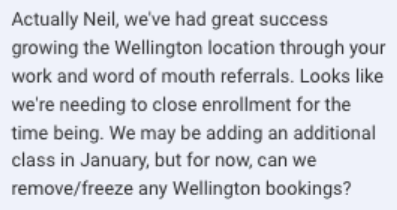
They're not auditing channels. They're counting a result, and they're out of room. That's the right relationship with this question.
How do I tell which marketing is actually working?
Stop trying to allocate credit per parent and start counting the whole machine over a period.
Three numbers, for the school as a whole, every month: trials booked, trials that showed, students enrolled. Then compare the month with the month before it. That's it. No channel split, no ticked boxes, no weighting.
Why those three and not lead cost? Because the end of the line is the only place the truth shows up. From the book:
"If an ad is getting a very low lead cost but none of those leads are becoming students, then it might not be communicating to viewers in the way you want it to and it might be something you should cut."
"So look at the overall cost to get students to show and enroll and try to make decisions based on this, not just on the lead cost."
That's how we run our own side of it. Ads and targeting that don't produce students get switched off, and the ones that do get copied into other schools. Neil has a genetics degree and compares it to survival of the fittest, which is about right. Every ad, target and lead form we run on Meta sits in one database across all our accounts, which is the only reason the comparison is possible at all. Decisions come out of that, not out of opinion.
This month: ___ booked, ___ showed, ___ enrolled Last month: ___ booked, ___ showed, ___ enrolled
If you want to keep asking parents where they came from, ask it in two parts instead of one, because one question can only return one answer:
"Where did you first come across us?" and then "What made you book this week?"
The first answer is usually a channel. The second is usually a reason, and the reason is worth more.
The half of the data only you have
Everything that happens online, we can track. Neil has been saying the second half of this since 2023:
"We have data tracking in place for everything we do online. This allows us to drive the best results possible in terms of the data we can see."
What none of that reaches is your lobby. Who the lead really turns out to be happens offline, in front of you, and it's the thing that most often separates a campaign that improves from one that just runs.
If the wrong families are walking in, from our side it looks like everything is going brilliantly. We see people going through the door. You see people who were never going to join. The gap between those two pictures stays open until somebody tells us, which is why great communication is a bigger ingredient in results than most owners expect when they start.
The practical version is small. Tell us who showed, who enrolled, and who wasn't a fit and why. Those stages get fed back into the campaign, so the platform learns to find more of the families who actually enrol and fewer of the ones who were never going to. Bookings turn into attendance, attendance turns into enrolments, and once those are steady you can plan your weeks around them. The numbers to send your marketing company sets out what that report looks like, and what a student is worth over two years is the figure that makes the whole comparison mean something.
It's also the difference between being sold leads and being brought students, which is the whole argument for pay per show.
If I do run Google ads, how should they be set up?
We run Google for schools as well as Meta, so this isn't a channel we're talking you out of. It's a second channel, and it's a good one when the first is working. Checked against Google's own help pages this month, not the way it worked a few years ago:
The short Google checklist
- Target buyer keywords only. People actively looking for classes: "karate near me", your style plus your town, your style plus the ZIP. Add your own school's name, because that is the search the mother runs on Thursday, and you don't want a competitor's ad sitting above your own listing. Competitors' names can work too.
- Never bid on broad terms like "karate" or "martial arts" on their own. That buys you information seekers, people researching a school project and somebody three states away reading about belt colours.
- Use phrase and exact match. Both still exist, with the same syntax: quotes for phrase, square brackets for exact. What has changed is the default. A keyword you type in with no quotes or brackets is now broad match, so an untouched keyword list is a broad one.
- Add negative keywords. The terms you never want to pay for. Free, jobs, classes for adults if you only teach kids, the next town over if you can't serve it.
- Don't let Google pick your keywords for you. Neil's line in the book is not to use Smart campaigns, the simplified type where Google chooses what you show for. Google itself has started retiring them: as of September 2026 you can no longer create one through its API, though existing ones keep running. The principle outlasts the campaign type. Anything that offers to choose your keywords for a small local school is choosing how your money gets spent.
- Match the ad to the search, and the page to the ad. Somebody who searched for kids classes should land on a page about kids classes, with a headline that repeats what they typed.
- Add every sitelink asset you can. Sitelinks, call buttons, the extra links under the ad. They make your listing physically bigger in the results, which matters more than most owners realise.
- Cut the keywords that cost and don't convert. We started with six or seven hundred of them across our schools and narrowed that down to 32 phrase and exact match keywords that work well. That list came from switching things off, not from clever research.
The honest scale of it: every school we work with runs Facebook ads, and about one in ten also runs Google. If Google performed better we'd lead with it, because we're paid the same way either way. We keep testing other platforms too, because things change and the answer in two years might not be the answer today.
Where we sit in this
We find the families, get them booked and remind them to come. You welcome them, run a great first class, and enrol them.
The reason the attribution question matters to us at all is that we're paid when a student walks into your school. If you switch off the thing that was filling your mat because a form said Google, we both lose, and we find out about it a month later than you do.
So before you cut a channel, tell us what the whole school did: booked, showed, enrolled, this month against last. If the total is up, something is working whether or not the parents can name it. If the total is flat, that's a real conversation and it's one we'd rather have early. Neil's book, The Martial Arts Student Attraction Blueprint, has the Google and Facebook chapters in full, and what happens when you pause your ads is the article to read before you switch anything off on the strength of a ticked box.
Do this Monday
Take the "how did you hear about us" field out of your decision-making. Don't delete it, just stop ruling on it.
Put the three-column sheet on the wall instead, and for the next 30 days count booked, showed and enrolled for the school as a whole. Before you cut any channel, look at what the total did, not at what the parents ticked.
The short version
- Google ads reach parents who are already searching, so the intent is high. The number of them in your town each month is small, fixed, and split with your competitors.
- Facebook reaches the parents who haven't started looking, which in most towns is nearly all of them. That's why we start there, and why about one in ten of our schools adds Google.
- "How did you hear about us?" can only ever return the last step. The ad on Tuesday doesn't show up in an answer given on Friday.
- The same blind spot sits in your website numbers. Without separate tracking, every enquiry through the site gets credited to Google.
- Word of mouth is downstream of new students. Stop bringing families in and the referrals dry up about a term later.
- Count three numbers for the whole school each month: booked, showed, enrolled. Compare months, not channels.
- Tell your marketer who showed, who enrolled and who wasn't a fit. That half of the data doesn't exist online, and without it the targeting can't improve.
Questions owners ask
Do Google ads work better than Facebook ads for a martial arts school?
Usually not, and the reason is volume rather than quality. A Google lead searched for classes, so the intent is high, but only so many people in one town type that search in a month, and competing schools split it. Facebook reaches the parents who weren't searching yet, which in a small town is nearly all of them. Every school we work with runs Facebook ads. About one in ten also runs Google.
Is how did you hear about us accurate?
It's accurate about the last step and blind to every step before it. A parent who was served your ad on Tuesday, searched your school's name on Thursday and booked from your listing will say Google, and she is telling the truth as she experienced it. The box can't see the ad that put your name in her head, which is why it's a poor basis for switching a channel off.
Why do my new students all say they found me on Google?
Because Google is where people go to check you out once they already know you exist. The ad creates the demand, your listing and reviews confirm it, and the booking happens at the end. The same effect shows up in website leads: an owner with no separate tracking will credit everything that arrives through the site to Google Ads, when site traffic comes from several places, Facebook included.
How do I tell which marketing is actually working?
Count three numbers for the whole school each month: trials booked, trials that showed, and students enrolled. Compare the month with the month before it. Lead cost on its own tells you very little, because a cheap lead that never turns into a student is worth less than a dearer one that does. Judge by what happens at the end of the line.
Should a small martial arts school run Google Ads at all?
It can be worth it when your style is less mainstream, where there's little competition on the keywords and the people searching know exactly what they want. It also helps to cover your own school's name, because that's the search a parent runs after she sees your ad. As a school's only channel it is usually too small to fill a timetable.