An owner sent us this in the middle of a campaign that was working:
"Hey Neil. Is there a way to pause the marketing campaign? We are out of uniforms and they can't get us any for two weeks... between you and Google we have added around 40 trials in the last 30 days. If possible can we hit pause for two weeks and let us catch up. Will pausing hurt the campaign in anyway??? I don't want to lose the momentum."
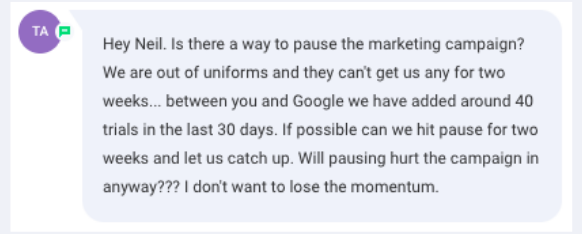
Three question marks. He'd already decided to pause. What he wanted was a straight answer about the damage, and nobody had ever given him one.
Here it is. A short pause costs you very little on the ad platform and quite a lot in the queue of people already talking to your school. Which of those two dominates depends almost entirely on what you do during the weeks it's switched off.
The platform side: there's a line at seven days
Meta publishes this, and it's more specific than most owners expect. Pausing an ad set for seven days or longer counts as a significant edit, and the ad set re-enters the learning phase when you unpause it. A pause shorter than that doesn't, by that rule.
The learning phase is the stretch where Meta's delivery system is still working out who to show your ad to. Meta's own description: during it, "the delivery system is exploring the best way to deliver your ad set", and that "can lead to less stable performance and a higher cost per result". An ad set normally comes out of it after about 50 results in the week following the edit.
Translate that into your school. A four-day pause over a bank holiday: no real cost. The two-week pause in the message above: yes, the ad set restarts in learning, and the first few days back are likely to be dearer per booking and bumpier than the fortnight before you stopped. That's a few days, not a season, and it's the correct price to pay for not booking trials into classes you can't teach.
What it is not is a reason to keep a campaign running while you're out of uniforms, out of mat space or out of instructors. The algorithm recovers in a week. A parent who walked into a bad class doesn't.
The bigger cost is the people already mid-conversation
This is the part almost nobody asks about, and one owner asked it perfectly:
"A question on pausing, can we just stop the ads and hunting for new leads and just process the ones already in-system or does pausing mean the 19 leads would be in limbo? Or would they be handed off to me or... how would that work?"

Switching the ads off stops new enquiries arriving. It does not delete the ones you already have, and it shouldn't stop anyone following them up. But that only holds if somebody actually keeps working them, and in most schools the person doing the following-up was the campaign, not the front desk.
So before you pause anything, get answers to three questions, from whoever runs your ads or from yourself if that's you:
- Who keeps texting the people already in the system, and for how long? Nineteen half-finished conversations are worth more than the next nineteen enquiries, because someone already paid to start them.
- What happens to trials already booked into next week? They're booked. They should still be reminded, and somebody should still ring the ones who no-show.
- Am I pausing the ads or pausing the follow-up? They're two different switches and only one of them should usually be off.
If the answer to the first one is "nobody", that's not a pause, that's an abandonment, and the money you spent getting those nineteen people is what you're actually throwing away. Not the momentum.
Two kinds of pause, and only one of them works
The good version has a condition attached. This owner's is the best example we've got:
"I need to train up this batch of new students (thank you SO much for what you do!) then we can turn on the fire hose again when it's time to add more students."

That's an intake plan. Absorb this group, then take the next one. Another owner did the same thing with a cashflow problem instead of a capacity one, and put a date on it: "I'm getting more than I expected, but I need to stop for this week due it is out of my budget and resume in the week after."
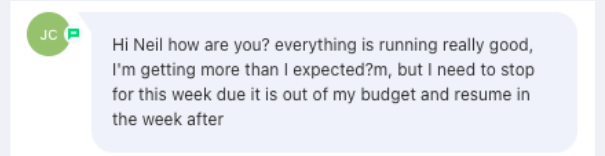
One week. Named. That's a pause you come back from.
The other kind reads like this, and it's far more common:
"Things are going good. I'll message you when we're ready for your marketing again."

There's nothing wrong with that message. He was busy and he was honest. But look at what isn't in it: a date. "I'll message you when we're ready" is the single most common way a two-week pause turns into six months, because there's no week in which being ready obviously happens. The new students settle, the term gets busy, and the question never comes back round.
The month you lose to a pause is never the one you paused. It's the fourth one.
Decide the restart date at the moment you switch it off, and put it in the calendar. You can always move it. You cannot move a decision you never made.
What the off weeks are actually for
A pause is only expensive if you spend it waiting. Four things to do with it, cheapest first.
Work the people already in your system. Every enquiry from the last few months who didn't book, plus anyone who booked and didn't show. You've already paid for all of them. One owner sent us this while paused, which is exactly the right use of the time:
"We have had three bookings that have all shown up for their first class. I was going to wait another week before revisiting with you."

The other list worth working in a quiet fortnight is everyone who used to train with you and stopped. It's cheaper than advertising and it runs out, which is why it suits a pause and doesn't suit a plan.
Fix the one thing that made you pause. Write it in a single sentence: no uniforms, no Tuesday instructor, nobody to take the enrolment conversation, no spaces in the 5.30 kids class. If you can't finish the sentence, you're not going to fix it in three weeks, and you should be throttling the campaign instead of stopping it.
Write down your intake steps. Who greets a trial, where their details go, who rings if they miss week two, who checks their gear fits. Twenty minutes with a pen. This is the work that only ever gets done when the phone stops.
Look at what the last run actually produced. Not leads. Trials that showed, enrolments, and what those students are worth to you over two years. That number is what tells you whether to restart at the same spend, higher, or lower.
The week before you switch it back on
Five things, and the whole list takes an hour.
- Count the spaces you can genuinely take, by class and by night, not as one total. Twelve spaces spread over six classes isn't the same offer as twelve on a Tuesday.
- Name the person on the desk for the two hours after each ad goes live. Speed of reply decides your show rate more than the ad does.
- Check your class times are still your class times. Half the pauses we see happened because the timetable changed. A booking into a class that no longer runs is worse than no booking.
- Check the offer still makes sense for the season. The trial that filled your September isn't automatically the one that fills your February.
- Set the spend deliberately and leave it alone for a fortnight. You're going back into a learning period. Changing the budget twice in week one is how you extend it.
What a good restart looks like
Master Jason Wadley runs a school in Lake Jackson, Texas. His campaign ran for under three weeks before he had to stop it, in his words:
"We started, I think we only maybe ran campaigns for I think less than three weeks. And yeah, just, it basically kind of overwhelmed you with students. So we had to, we had to pause things for a while and make adjustments to restart again."
Master Jason Wadley, in a video testimonial on our channel, at 2:09.
The phrase to steal is "make adjustments to restart again". He didn't switch it back on into the same school. He rebuilt his class schedule so it could hold the numbers, and he retrained his front desk to stop selling one person at a time and start handling four, five and six at once.
That's the whole difference. A pause where nothing changes is just a gap in your advertising, and you'll be sending the same message again in six weeks. A pause where one constraint gets removed is the cheapest growth work you'll do all year.
What we can't fix, said plainly
We can't fix a timetable with no spaces on it. We can't fix a front desk that takes two days to answer. We can't fix an enrolment conversation nobody is having. Those three are the usual reasons a school needs to pause in the first place, and they're the three that have to change during the pause for the restart to be worth anything.
If the families are walking in and not signing, more advertising makes that worse, not better — that's a different problem, and it's the one to spend a pause on.
Where we sit in this
We're paid when a student physically walks into your school. A pause costs us every penny we'd have earned that month and costs you nothing, because there's no retainer here and nothing to lock into. So read the above knowing we'd rather you were running.
It also means we've got no reason to talk you into restarting before you're ready. An agency on a monthly fee gets paid the same whether your Tuesday class has room in it or not. We don't, which is why the honest answer to "will pausing hurt?" has always been the short one: a little, for about a week, and far less than filling a class you can't teach.
If you're weighing up a pause, or sitting on one you never restarted, book fifteen minutes. Bring your timetable and the number of spaces you can genuinely take this month. If the answer is that you should fix the timetable before you spend anything, we'll tell you that on the call.
The short version
- Under seven days, the platform barely notices. Over seven, Meta puts the ad set back into learning when you restart and the first few days cost more per booking. That's a real price and a small one.
- The expensive part is the conversations already running. Ask who keeps following up the people in your system while the ads are off, and make sure the answer isn't "nobody".
- Never pause without a date. "I'll message you when we're ready" is how a fortnight becomes half a year.
- Spend the pause removing one constraint. Name it in a sentence, fix that one thing, and write down your intake steps while the phone is quiet.
- Restart into a school that's changed. Wadley rebuilt the schedule and retrained the desk before switching back on. That's the difference between a pause and a gap.