Find the exact moment your marketing company gets paid. Whatever happens at that moment is the thing they're being paid to produce. Everything after it is goodwill.
That's not meant cynically. Good people work at agencies billed every way there is, and plenty of them do more than they're paid for. But if you want to know what an agency will spend its Tuesday on, look at what triggers the invoice, not at what's in the proposal. The proposal describes intentions. The invoice describes the business.
Four triggers are common in this industry, and they sit at different points on the same chain:
Somebody clicks → somebody fills in a form → somebody books a class → somebody walks in → somebody enrols.
A retainer gets paid at the start. Pay-per-lead gets paid at the form. Pay-per-booking gets paid at your calendar. Pay-per-show gets paid at your front door. Nobody gets paid at the last link, and it's worth knowing why.
How does a marketing retainer work?
You pay a fixed amount every month. The agency gets the same whether you enrol thirty students or none.
The honest case for it is that it funds real work. Someone can spend a month rebuilding your creative, or sit out a bad January without panicking, because their rent doesn't depend on this month's numbers.
The problem is specific. A retainer turns your growth into somebody else's fixed income, and fixed income has no upside in trying harder. Their best month and their worst month pay the same. What it does reward is keeping you subscribed, which is a different skill from filling your mat, and it's usually practised through reporting rather than results.
One owner described it from the inside, writing to another owner who'd asked him for a recommendation:
"A lot of other companies we have used made us sign a 6 month contract. Unfortunately, we never saw results and wasted so much money. They would always say we need to give it time but that is just to lock you in financially (personal oppinion)."
A school owner, in an email to another owner.
He flags it as his own opinion, which is the right way to read it. Sometimes an agency genuinely does need time. The trouble with "give it time" is that nothing can disprove it. It's exactly what you'd say if you needed three more months, and exactly what you'd say if you had nothing. Master Wallace Westall in Florida put the same thing in numbers: the agencies he used before us were good for four or five weeks, then it dropped off.
A six-month contract is a bet, and you're the only one placing it.
What does pay per lead mean?
You pay per form fill, per opt-in, per name and number. Now growth is in the agency's interest, which is a genuine improvement.
It just moves the incentive to volume of forms. And a form is cheap to produce badly. Widen the audience, promise something nobody has to mean, put the form in front of people half-watching a video, and the cost per lead drops nicely. Every one of those makes the invoice look better and your week worse, because you're the one ringing the numbers.
That's the part nobody counts: your staff absorb the quality problem. Somebody at your desk spends their evening calling people who don't remember filling anything in. The agency's number is fine. Your front desk is doing unpaid quality control on it.
One owner posted publicly about a lead supplier he'd used before:
"Spent a ton of money for little to no results. They made me use an exel spreadsheet and there was no way to follow up with leads unless I checked my emails 24-7. Who has time for that?"
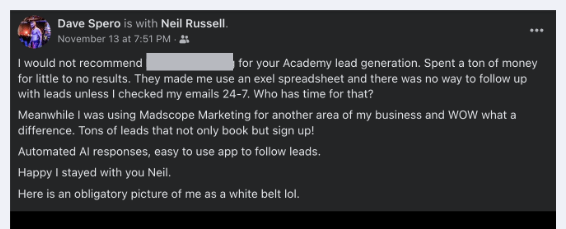
The spreadsheet is the giveaway. Handing you raw names in a file is the logical end point of being paid at the form. Delivery is complete, and everything past it is your problem. The measuring stops exactly where the paying does.
To be fair to the model, per-lead billing works fine in industries where a lead is close to a sale and the buyer has a sales team built to work it. A martial arts school usually has neither. Your closer is you, between classes.
What is pay per appointment?
You pay when somebody is actually on your calendar for a trial, one link further down the chain and a much higher bar than a name on a list. A booking means a real person picked a real time.
It's also where the gap opens up. Booked isn't the same as present. Every school knows this, and one owner said it plainly in the middle of recommending us, without being asked:
"Please keep in mind that not every booked appointment will show. They dont with any of our other marketing as well so that is normal."
A school owner.
He's right, and his sentence stays exactly as he wrote it, including "with any of our other marketing as well", because that's the part that stops it being a complaint about one supplier. People book with sincere intentions on Sunday and their week falls apart by Wednesday. No billing model fixes that.
What per-booking billing does is put the whole consequence on you. The invoice is settled the moment the slot is taken. Whether a body arrives is, commercially, none of the agency's business. You see it in reminders that stop after one text and follow-up that ends when the appointment is made rather than when it's kept. Almost everything that actually moves a show rate happens in the days after the booking, and that's exactly the window nobody is being paid to care about.
What is pay per show?
You pay when a person is physically in your building. That's our model, so read this section knowing whose side it's written from.
What it changes is simple. The chase after the booking becomes the supplier's problem, because the supplier hasn't earned anything until it works. Reminders, reschedules, the person who goes quiet on Thursday. That work sits with whoever gets paid at the door. And there's no reason to pad volume, because a form fill from somebody who was never going to drive over is worth nothing to us.
Here's what it doesn't do, and what to check.
It doesn't enrol anybody. We're paid when they walk in. The next twenty minutes are your building, your instructor, your front desk. If your trial class is average, pay-per-show delivers people to watch an average trial class, and you'll have paid for the privilege. The same owner was clear about that too: "everyone who shows may not enroll in your school for one reason or another (cant afford it, or the schedule may not work, etc)."
It doesn't fix capacity. It often makes capacity worse, fast, which is a whole separate problem.
And the shows have to be the right shows. Somebody who was never going to train (wrong age, wrong side of town, wrong price bracket) is worth nothing to a school, so they're worth nothing to a supplier who wants to keep that school. That's why we watch enrolment as closely as you do. Ask any pay-per-show supplier what proportion of shows enrol, and if they don't know, ask why not.
Nobody bills at enrolment, by the way. You'll occasionally see it offered and it rarely survives contact with reality, because the agency would be betting its revenue on your close rate, your pricing and whether your instructor was having an off night. That's not a bet a supplier can price. Which is worth knowing, so that "we only get paid when you enrol" sets off the right alarm rather than the wrong one.
What to ask before you sign anything
Five questions. Ten minutes, and more informative than any case study, including ours.
- What exact event triggers your invoice? Make them name the moment. Click, form, booking, arrival. If the answer takes more than one sentence, that's the answer.
- Do you charge me monthly whether or not it works? A company that's confident in what it produces is usually willing to get paid for producing it.
- If there's a guarantee, read the conditions out loud. Guarantees are how monthly fees get sold. Then you find the clause: call every lead within five minutes, ring them ten times in a day, and if you miss one you don't qualify. Ask what has to go wrong for the guarantee to pay, and who decides.
- What's your client retention? This is the one most owners never ask and it tells you the most. A company that works with a school for two or three months and moves on to the next one is a company whose schools keep leaving. Schools pause for good reasons, ours do it when they're too full, but ask how many come back.
- Whose ad budget is it, and whose account does it sit in? If the ads run somewhere you can't see, you can't audit the cost of anything, and you can't take the data with you when you go.
A last word on contracts, from the same owner:
"The great thing about Madscope is there is no contract and you can leave whenever you want. To me that spoke volumes because we had nothing to lose when we signed up."
A school owner.
That one flatters us and it's here anyway. The general point holds whoever you buy from: the supplier who most needs you locked in is telling you the most about their model.
Where we sit in this
We're paid when a student walks into your school, and not before. There's no contract, so we keep a school by filling its classes, month after month, not by holding it to a term.
That structure puts our income and your growth on the same side of the table, which is about the most you can honestly ask of a billing model. The rest you judge on evidence: the students walking in.
Before you speak to anyone, us included, work out what one student is actually worth to you over their whole stay. That number is what turns any of these prices into a yes or a no.
If you want ours against that number, book fifteen minutes. Bring the number of spaces you can genuinely take this month, and we'll tell you what we think your town will produce.
Questions owners ask
Is it worth paying for leads?
It can be in industries where a lead is close to a sale and there's a sales team to work it. A martial arts school usually has neither: your closer is you, between classes. Paid per form, a supplier is rewarded for volume, and your front desk ends up doing unpaid quality control on the leads.
What is pay per performance?
Pay per performance means the supplier is paid only when a defined result happens. The question is which result. In martial arts marketing it can be a lead, a booked trial or a student physically walking in. Ask what exact event triggers the invoice, because that event is what the supplier is really being paid to produce.
What is the difference between pay per lead and pay per appointment?
Pay per lead bills when someone fills in a form. Pay per appointment bills when someone is booked on your calendar for a trial, which is a higher bar. Neither pays on arrival, so with both, the chase after the booking (the reminders, the reschedules, the person who goes quiet on Thursday) falls to you.