A business owner put the question on Reddit in one line. "I get 5-10 per mo saying I'll only pay when a client lands. Sounds too good to be true. What's the catch?"
If your inbox looks like his, here's the answer from a company that gets paid that way.
What's the catch with pay per show marketing?
The risk moves off you. It doesn't disappear.
Somebody else now carries the cost of finding families, getting them booked and reminding them to come, and that part genuinely leaves your books. What stays is everything that happens after a parent pulls into your car park.
Your room stays yours. A class that's full at six on a Tuesday is still full when ten more children book into it.
So does the first class. The instructor who takes a nervous seven-year-old through their first forty-five minutes is you or one of your staff, and nobody in an ad account can do that bit for you.
And so does the enrolment. The conversation at the desk afterwards is yours from start to finish.
We say it the same way to every school we talk to. We find the families, get them booked and remind them to come. You welcome them, run a great first class, and enrol them.
What happens if it works and you can't take them all?
This is the catch owners feel first.
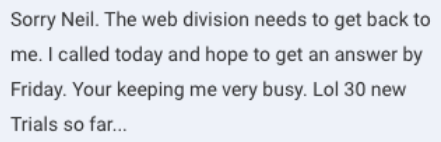
When the bookings land, the pressure lands on your timetable. One of our schools wrote in during a busy run, halfway through a note about something else.
"Your keeping me very busy. Lol 30 new Trials so far..."
Another owner asked us to cap his daily bookings so he could keep up, and was careful to say why.
"Im not saying this because want to scale down, I just need to find more closers to keep up with what your team is doing!"
He was at 88 members when he signed with us, and his own count was more bookings in two days than he usually saw in a month. Those are his figures for his school, not a rate to plan around.
Neither of those is a marketing problem. They're good weeks that arrived before the staffing did. The fix depends on whether you're short of space, instructors or desk cover, and we go through each one in what to do when your school can't handle the growth.
Tell us early and we can slow the bookings down or speed them up. We'd much rather do that than watch class quality drop, because the families already paying you are the ones who notice first.
Do I still pay if the family doesn't sign up?
Yes, and you should want it that way.
The payment is for the walk-in. The signing is yours. Your marketer wasn't in the room, can't hear the conversation, and can't change the price on your wall. Anyone who agreed to be paid only on signings would have to charge far more for each one to cover what they can't control, and you'd both be arguing about who gets the credit for the rest of the year.
The walk-in is the last step we can genuinely move, so that's where the invoice sits. If you want the longer version, we compare pay per lead and pay per show side by side.
What it does mean is that your trial itself has to work. If most families who try a class don't join, more walk-ins just buys you more chances to lose the same way. Read how trials turn into enrolments before you spend anything with anybody.
Who is pay for results marketing wrong for?
Three schools, and we'd rather say so on the call than afterwards.
The first is the school that hasn't proved its own market yet. If families in your town haven't joined and stayed with you in any number, advertising can't create that for you. Build your first students without paid ads and come back to us.
The second is the school with no room and no plan to make any. If your busiest class is at its ceiling and you've no intention of adding a time or a coach, more walk-ins just means turning families away. That's worse than a quiet week, because those parents talk to other parents.
The third is the school where nobody can answer a text. A parent who books at eight in the evening still has the phone in their hand. A fast reply does more for your show rate than anything we can change in an ad account, and it has to come from your side of the door. We set out how we would do it in the first fifteen minutes after an enquiry.
If one of those is you, the honest answer is not yet, and you'll hear it from us.
What should you ask a company that wants paying on results?
That Reddit thread wasn't short of answers. One reply named the thing to check first.
"the catch? they want a setup fee 2-5k upfront"
He went on: they disappear when the results they claimed don't arrive, and then you're fighting them to get a refund.
Another put it as two likely cases. "2 options they make you pay for the tech setup/ for a 1 time setup fee. Or they're new and are looking for case studies".
Both are fair warnings, and they turn into three questions worth asking anybody, us included.
Do you charge a monthly fee as well, and what does it cost me to start? Get a number before the call ends.
If the results don't come, what happens, and how do I stop? Read that answer slowly if it arrives as a guarantee, because the conditions are usually what decides whether it ever pays out. We go through the fine print in a marketing guarantee line by line.
What's your client retention? A company whose schools move on after a month or two wasn't keeping them happy. Neil tells owners to ask that one every time.
The one page to fill in before you book any call
Ours or anybody's. Write these three lines on a single sheet and take it in with you.
1. Spaces. For each of your beginner class times this week, how many more children could you take without the class getting worse? Add them up. That's the most students anybody can get you this month.
2. Trials and enrolments. Last month, how many families tried a class, and how many enrolled? Two numbers, in that order. If you can't answer, that's the first thing to fix and it costs nothing.
3. Who replies. For each teaching night, name the person who answers a new enquiry by text within fifteen minutes. A name, not a role. If the honest answer is nobody, your show rate is already paying for it.
Take that sheet to a sales call and you can't be sold the wrong thing. We'd rather you brought it than took our word for any of this.
Where we sit in this
We get paid when a student walks into your school. There's no retainer and no contract, you're not locked in, and nobody is charged for a pause. That's the whole public pricing story, and the rest belongs on a call where we can look at your actual timetable.
Getting paid that way is also why we're straight with you about the room, the trial and the desk. If your classes are full or your trial doesn't convert, we lose money sending you families, so we'd rather fix the order than take the booking.
What to do Monday
Pull last month's trials and count how many of them enrolled. That one number tells you, and tells us, whether more walk-ins will turn into students.
Bring it to a call with anybody you're considering. If you'd like ours, book a time here and bring your timetable with it.
Questions owners ask
What's the catch with pay per show marketing?
Only the marketing risk moves. Somebody else carries the cost of finding families and getting them booked. You still carry the room, the instructor who teaches the trial, the person who runs the enrolment conversation, and the job of telling your marketer who turned up and who fitted in. If one of those is weak, more walk-ins will show you how weak it is.
Is pay per show marketing worth it?
It's worth most to a school that already enrols the families who walk in and has room for more of them. Pull last month's trials and count how many of them enrolled. If that number is healthy and you've got spaces, more walk-ins turn into members. If it's low, fix the trial first, because paying per show just buys you more chances to lose the same way.
Do I still pay if the student doesn't sign up?
Yes. The payment is for the walk-in, not the signature. Your marketer wasn't in the room when the family decided, can't hear what was said, and can't change the price on your wall. Paying at the last step your supplier controls is what keeps the deal clean. The signing is yours, and so is the money that follows it.
What should I ask a marketing company that only gets paid on results?
Three things. Do you charge a monthly fee as well, and what does it cost me to start? If the results don't come, what happens, and how do I stop? And what's your client retention, because a company whose schools leave after a month or two wasn't making them money. Ask all three before you talk about anything else.