A school owner who was shopping for marketing emailed one of our clients directly and asked him, owner to owner, whether Madscope was worth signing up for. The reply ran to six numbered points and about six hundred words. This is the line that opens it:
"I totally understand where you are coming from when looking for a marketing company to help build your business. We have been in the same boat over the years! Its a waste of money and time if they cant produce. You really dont know what company to use because everyone will tell you what you want to hear but never deliver those results."
A school owner, in an email to another school owner. Reproduced as written, typos included. He is not named because the email is unsigned in the source, and the owner he is writing to is not named either.
That's the actual problem, and it's worth being precise about it. You can tell a good agency from a bad one. You just can't do it on a sales call, because the bad one has had far more practice at sales calls than the good one has.
So the evaluation can't happen on the call. It happens in what you ask for before the call, what you ask during it, and how you read the answers afterwards. Below is how we'd do it if we were the ones buying, including the parts that are inconvenient for us.
Read a reference for its caveats, not its praise
Most owners ask for references and then read them wrong. A reference that's wall-to-wall positive isn't a strong reference, it's a curated one. What makes the email above useful is that its author keeps interrupting his own recommendation to tell the other owner what won't happen.
He does it three times without being asked. He says plainly that not every booked appointment shows up, and adds that this is true of all his other marketing too. He says that some of the people who do show won't enrol, and gives the reasons: they can't afford it, or the schedule doesn't work. On one number he refuses to commit at all, writing "dont quote me because I would have to look it up". Then, having limited his own recommendation three times, he still says to call.
That's what a real reference sounds like. The one to be suspicious of is the one that reads like a testimonial. When an agency hands you a customer, your first question shouldn't be "were you happy". Everybody says yes to that. Ask what didn't work, what you had to fix at your end, and what you'd want to know if you were starting again. If the reference can't answer that, the agency picked them for you carefully, and you have learned something anyway.
His caveat about show rates is quoted in full on our page comparing pay per lead and pay per show, because it's the honest centre of that argument as well.
The six things worth asking on the call
1. What exactly are you counting, and at what point do I pay?
A lead, a booked appointment, a person who physically arrives and an enrolment are four different events, and the drop-off between each one and the next is big. So an agency quoting you a cost per lead and an agency quoting you a cost per show aren't competing on price. They're selling different things, and comparing the two numbers directly will mislead you.
Ask where in that chain the invoice is triggered. Then ask what happens to the invoice if the person books and doesn't turn up. The answer tells you what the agency is actually being paid to produce, which is the only reliable predictor of what it will produce. We wrote the four models out in full here.
2. What does the follow-up actually consist of, and who does it?
This is where suppliers separate fastest, and it's easy to check, because the answer is operational rather than strategic. Nobody has to be clever about it.
One owner posted publicly about a lead-generation supplier he left. The supplier's name is blanked out in his own screenshot, and we have kept it blanked:
"I would not recommend ████████ for your Academy lead generation. Spent a ton of money for little to no results. They made me use an exel spreadsheet and there was no way to follow up with leads unless I checked my emails 24-7. Who has time for that?"
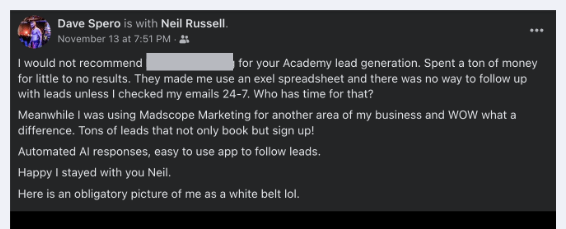
Notice what the complaint is really about. He isn't saying the leads were fake. He's saying the leads arrived in a format that made following them up a second job, and he already has a first job. A spreadsheet of names isn't lead generation, it's homework.
So ask the mechanics. What happens in the first five minutes after somebody puts their details in. What happens on day three when they haven't replied. What happens when a booked appointment doesn't show. Does anything reach out to reschedule them, or does that land on your front desk? The owner who wrote the reference email describes that specific piece as the reason he stopped thinking about it:
"If an appointment doesnt show for any reason then just click a button online to move it to that category. Then the online system will reach back out to reschedule them."
From the same email, one school owner writing to another.
Whatever they answer, ask to be shown the actual thing rather than told about it. Screen share is free.
3. Who do I talk to when it goes wrong, and how often do we meet?
Ask for the name of the person you'll actually deal with and how often you'll speak to them, and ask it early enough that they can't go and invent an answer. The reference email answers this unprompted and in detail:
"We have a monthly meeting with our rep going over any questions we have. In the beginning I believe it was every week or every other week to get you acclimated. Our rep, Ankit, is awesome! If he doesnt have the answer to any of my questions he will get back to me via email/text ASAP. What I like about these meetings is that they are very precise so they dont waste your time or theirs and they get you the info you want. I always look to see if we need to increase/decrease our budget depending on our stats."
From the same email, one school owner writing to another.
Two details in there matter more than the enthusiasm. The cadence is heavier at the start and lighter later, which is the right shape, because the first six weeks are when the decisions are made. And the meeting has a job: he uses it to move his own budget up or down against his own numbers. A monthly call that exists to reassure you is a cost. A monthly call where you change something is the product.
4. What happens if this works faster than my school can absorb?
Almost nobody asks this, and it's the question that has cost our clients the most money.
Master Jason Wadley in Lake Jackson, Texas took thirty memberships in under fourteen days and had to stop. He's careful about the number and so are we: thirty memberships, not thirty people, and about a third of them brought a sibling. He paused the campaign inside three weeks because he couldn't process the intake, rebuilt his class schedule and retrained his front desk before restarting.
We have that request in writing more than once. One arrived as a one-line email:
"Can you please place all our ads on hold effectively immediately? We currently don't have the appropriate staffing needs to properly manage the influx of people. We will be in touch soon to reevaluate."
A school owner, in an email to Madscope. Anonymous, because the source does not name him.
An owner in Lima, Ohio, who had sat at sixty to seventy members for years, signed thirty-five to forty in his first forty-five days and hired two appointment closers and an assistant coach to cope. His own summary is the sentence we'd put on the wall:
"All this was on my fault, because I should have 10 to 20 more. I just wasn't ready for it at the beginning. So when you make that call, be ready."
Jessy Austin, Lima's Total Revolution Training Facility, on video at 9:09.
So ask what happens when you say stop. Can you pause inside a month without penalty, how fast does the spend actually stop, and does pausing cost you your place or your setup? An agency that has no answer has never had a client succeed quickly enough to need one. If your honest read is that a full pipeline would break your timetable tomorrow, work through that first and buy the marketing second.
5. What are you not going to fix?
Any supplier worth hiring can tell you where their work stops. The ones who can't will let you believe they fix everything, and you find out in month three.
Some concrete edges, from owners rather than from us. The Lima owner was already at the top of Google and had been boosting posts, and neither did anything for him; ranking can't manufacture demand that nobody in your town is searching for. An owner in Florida describes his earlier suppliers as "good for four or five weeks" before the results dropped away, which is a pattern rather than an accident. A New York owner who had been through four agencies before us got sixteen contracts out of one of them across three months.
We're not repeating those agencies' names. He said them on camera and they're audible on the recording, but a page like this one isn't the place to publish another business's name attached to somebody else's bad quarter. The number is the useful part, and the number is what we have verified.
The question to ask is the direct one: what do you need me to have in place for this to work, and what will you not do? Answers that should reassure you include a front desk that can answer a phone, somebody who rings back the same day, and a timetable with actual spaces in it. An agency that says it needs nothing from you isn't being generous. It's being vague.
6. What do I own when I leave?
Short version, because we wrote this one out separately: the ad account, the tracking, the phone number, and the lead list should all be in your name. If any of the four sit inside the agency's account, leaving means starting again, and both of you know it.
The full list of what to check and what a fair exit looks like is here. It's the least glamorous question on this page and the most expensive one to get wrong.
Three answers that should end the call
- "We guarantee X students." Nobody can guarantee an enrolment, because enrolment happens at your desk, in a conversation the agency isn't in. Shows can be committed to. Enrolments cannot.
- "You'll need to sign for six or twelve months so we can optimise." Optimisation is real and takes time. A term isn't the only way to buy that time, and a supplier who needs your signature to stay funded through the bad months is telling you about their cashflow, not your campaign.
- "Here's our average client result." Ask which clients, in which towns, at what price point, over what period, and how many clients are excluded from the average. If the answer softens, the number was decoration.
None of those three make an agency dishonest. They make it unverifiable, which for a buying decision is the same problem.
Where we sit in this
We're an agency. We're on the list you're evaluating, so read the page knowing that.
We've written it to be usable against us. Every question above can be turned on us and we'd rather you did. Ask what we count and when you pay, which is when somebody physically walks in. Ask us about the client who told us to stop the ads because he couldn't staff the intake, because we quoted his email up there. Ask what we don't fix, which is the enrolment conversation, the timetable and the front desk. Ask for a reference and then push that reference for the caveats, the way the email at the top of this page does without being asked.
The thing we'd want you to check hardest is the one that flatters us most. We've got no contract, and that sounds like a benefit until you work out what it actually is: it moves the risk of being mediocre from you to us. That's the point of it, and it's also why we'd rather you pushed a reference than took our word.
If you want to run the six questions past us live, book fifteen minutes. Bring your class timetable and the spaces you've got now, not your ad account. What you can absorb is the constraint that decides everything else, and if we don't think we can fill those spaces we'll say so on the call.
The short version
- The reference matters more than the pitch. Read it for what it says won't happen, not for the praise.
- Find out what gets counted and when you pay. Leads, bookings, shows and enrolments are four different products.
- Ask what happens when it works too fast. One owner stopped inside three weeks; another wishes he had been staffed first.
- Get the ownership questions out of the way early. Ad account, tracking, phone number, lead list, in your name.
- A guaranteed enrolment, a required term, and an unexplained average are three good reasons to keep looking.