A mother parks up at 4.55pm with a seven-year-old who has been talking about this all week. She has taken an hour off work. The class she booked starts in five minutes, and your instructor can't let the child on the mat, because nobody has signed anything.
Now you're stood at the front desk with a clipboard, a nervous child, and about ninety seconds to sort out a form that asks for an emergency contact and a medical history. Either she fills it in while the warm-up happens without her child, or she watches from the side, or she goes home.
You paid for that visit. However you get your trials, whether that's ads, referrals or the sign above your door, that was a real person you persuaded to give up a Tuesday. And the thing that broke it was a PDF.
This one came in from a school owner on the day his first lead arrived, before he had received a single booking:
"Could you send the Leads a link to sign the waiver when the booking is confirmed. This is important, as we will not be able to admit the child to training if the waiver is not filled in. It is easy to fill out online and takes 3 minutes for parents."
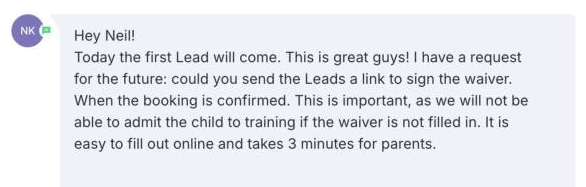
He asked before it cost him anything. Most owners ask after.
What the form is actually doing
A waiver has two jobs and owners tend to think about only one of them.
The job everybody thinks about is the legal one. You want a signature that says the family understood this is a contact sport and accepted the risk. How much that signature is worth depends entirely on where your school is. In the United States, parental releases signed on a child's behalf are treated very differently from one state to the next: some courts enforce them, others have held that a parent can't sign away a child's right to sue, and a few states have settled it by statute. Your insurer and your attorney know which of those you're in. We don't, and neither does any article you'll read on this subject.
So treat the legal half as theirs, not yours.
The second job is the one that decides whether your Tuesday works, and that one is entirely yours. The form is how you find out, before the child is on the mat, that she has asthma, that the inhaler is in the bag, that her dad is the emergency contact and not her mother, and whether you're allowed to put her photograph on Facebook. None of that is legal protection. It's operational information, and you need it in your hand ten minutes before class rather than ten seconds before.
Which is why the delivery matters more than the wording. A perfect waiver signed at 4.59pm has already failed at the second job.
The field list
Here's what tends to be on these forms in a school that runs smoothly. Copy it, hand it to whoever drafts yours, and let them write the actual legal language. We're a marketing company. We aren't giving you a document to sign people on, and you should be wary of anyone who does.
About the student
- Full name of the student, and date of birth. Not age. Ages go stale and your system needs the birthday anyway.
- Address.
- Which class they're booked into, and the date. This is the field most home-made forms miss, and it's the one that lets your front desk match a signature to tonight's register.
About the person signing
- Full name of the parent or legal guardian, and their relationship to the student.
- Confirmation that they're the parent or legal guardian with authority to sign. Grandparents and new partners bring children to trial classes constantly.
- Phone and email.
Emergency and medical
- Emergency contact name and number, and it must be someone other than the person signing.
- Any medical conditions, injuries, allergies or medication that affect training. Give it a proper text box, not a yes or no tick.
- Whether the student carries anything on them: inhaler, EpiPen, insulin.
- Consent to obtain emergency medical treatment if you can't reach anyone.
The risk acknowledgement
- The actual waiver and release language, written or approved by your attorney, naming your school as the legal entity on your insurance rather than the name on the sign.
Photo and video consent
- A separate, clearly marked yes or no. Not bundled into the main signature.
The signature
- Typed name, date, and an electronic signature.
Thirteen fields sounds like a lot until you time it. The owner above reckoned three minutes for parents, and he was right, because half of those fields are a name and a phone number.
Photo consent is its own question, and it is your question
Point twelve is the one that will bite a school owner specifically, because you're running ads and posting to social, and the best photograph you'll ever take of a child's first class is the one taken during the trial.
Bundle the photo permission into the main signature and you have a problem in both directions. Some parents won't sign the whole form because of the one line about photographs, and you've lost a trial over something optional. Others will sign it without reading, and you'll find out what they actually thought when a picture goes up.
Make it a separate yes or no. Then make that answer visible to whoever is on the mat. A list of first names on the instructor's clipboard is enough: these are the ones we don't photograph. There's no point collecting the consent if nobody at 5pm knows who said no.
And a foster carer or a parent in the middle of a custody dispute has a real reason to say no that has nothing to do with you. Don't chase it.
When to send it
Three sends, and the first one does most of the work.
- In the booking confirmation. The moment the appointment is set, in the same message as the address and the class time. This is what the owner above was asking for, and it's right: the confirmation is the one message you can be sure they open, because it contains the details they need.
- In the reminder the day before. Only if they haven't signed. Sending "please sign the waiver" to someone who signed it yesterday makes your whole reminder sequence feel automated, and that costs you show rate.
- On the morning of, to the ones still outstanding. This one is a text, not an email, and it's worth writing by hand: "Hi Sarah, looking forward to seeing Ellie at 5. Two-minute form here so you aren't filling it in at the desk."
That third message is doing something beyond the form. It's a human being from the school making contact on the day, which is the single biggest lever on whether anybody turns up at all. We've written the longer version of that in why booked trial students don't show up.
One rule that matters more than the schedule: make the link go straight to the form. No login, no account creation, no app download. Every extra screen costs you signatures, and a parent who abandons the form on Sunday night is a parent who arrives unsigned on Tuesday.
What to do when somebody turns up anyway
They will. Not often, but they will, and you want the answer decided in advance rather than improvised in front of a child.
Have a tablet on the front desk with the form already open. Not a link they have to find in an email, and not a paper form you'll have to type up later. Open, waiting, on the counter.
Then handle it like the trained-for thing it is. Somebody who isn't teaching greets them, takes them to the desk, hands them the tablet and explains why in one sentence. "Two minutes, it's the medical details and the emergency contact, we can't let her train without it." A parent who understands that you're asking about her child's asthma, rather than about your own liability, doesn't resent the delay.
The part to get right is the child. She doesn't need to stand at the desk watching her mother type. Send her to get changed, let the instructor say hello, put her in the warm-up. The form is an adult problem and it should stay with the adults.
What you don't do is let her train unsigned and tidy it up afterwards. That's precisely the situation the form exists for, and your insurer will have a view about it.
The version of this that costs you the most
There's a worse case than the family at the desk, and it's quiet.
A parent gets the form, starts it on her phone, hits a field she can't answer, and stops. Perhaps it asks for a policy number. Perhaps it demands a medical history she would need to call the doctor for. Perhaps it asks her to create an account. She means to come back to it. She never does.
On Tuesday she doesn't come either, because the thing she failed to finish is now a small embarrassment, and not showing up is easier than explaining.
You'll never see that one. It goes in your books as a no-show and you'll blame the lead, or the ad, or the agency. So take your own form, open it on your phone, and fill it in as though you were a stranger. Anything in there you can't answer in one go from a car park, take it out and ask at enrolment instead.
That's the difference between a form for enrolling members and a form for admitting a trial. Ask a trial visitor for the minimum that lets her child train safely. Everything else can wait until she has decided to stay.
Where we sit in this
We're paid when a student physically walks into your school. So a booking that ends with a family driving home unable to train is a show we don't get paid for, which is why we care about the paperwork more than a marketing company normally would.
It also means we'll say the unhelpful thing: we can't fix this from an ad account. We can put the link in the confirmation, and we do when a school asks us to. Whether the form behind that link takes three minutes or eleven is on you, and it's worth an hour of your week.
If you want the rest of the admin that decides whether a campaign turns into members, we put it in what the first month with a marketing agency actually looks like. And if you want to talk through what your own trial process would need to hold, book fifteen minutes and bring your booking confirmation exactly as it goes out today.
The short version
- Put the waiver link in the booking confirmation, then the day-before reminder, then a hand-written text on the morning for anyone still outstanding.
- Ask a trial visitor for the minimum that lets her child train safely. Everything else belongs at enrolment.
- Photo consent is a separate yes or no, and whoever is on the mat needs to know the answer.
- Keep a tablet on the desk with the form open, and send the child to get changed while the adult signs.
- The legal half belongs to your insurer and your attorney, not to an article. What belongs to you is making the form short enough that it gets finished in a car park.