Master Jason Wadley runs a taekwondo school in Lake Jackson, Texas. He'd been at about 225 students, lost roughly 60% of that to Covid, and relaunched his programmes with maybe 60 or 70 people. He was running a deliberately minimal class schedule and planning to scale it up as students came back. About two weeks into working with us he had to cut the campaign off and redo the schedule so he could handle the numbers. Here's how he described what came through the door:
"We signed up, what, 30 people in less than 14 days. Now that's not 30 people, that's 30 memberships, and 30% of those had a sibling that came in."
Master Jason Wadley, Lake Jackson TX, at 1:33 in his video testimonial.
He stops himself, mid-sentence, from saying 30 students. He knows the difference between a membership and a body on the mat and he won't blur it, even though the blurrier number would make him look better.
Most owners do blur it, in both directions. They pay for a student, one sibling turns up alongside them, and it lands in the school as a pleasant surprise rather than as something they counted, priced or made space for. Then the classes are fuller than the enrolment sheet says and nobody knows why the Tuesday 5pm feels tight.
A sibling is not a second membership, and the difference matters
Wadley's framing is the right one to steal. A sibling arriving with a new student usually means:
- One more body on the mat. Real floor space, real instructor attention, real ratio.
- Some more money, but rarely double. Nearly every school runs a family rate, so the second child is at a discount. That's fine. It's why families join. But it means the sibling is worth a fraction of a full fee, not a whole one.
- No extra acquisition cost at all. You paid to get the first one in. The second one walked in behind them.
Those three don't move in step, which is why counting in "students" gets owners into trouble. Count in memberships when you're working out revenue, and count in bodies when you're working out whether a class is full. They're different numbers and they answer different questions.
What it does to the arithmetic
We wrote a whole piece on what a martial arts student is actually worth. The point of it is that pricing marketing against a monthly fee is what makes growth look unaffordable in two seconds flat. The sibling is the part of that calculation most owners leave out.
Use the illustrative numbers from that article: $150 a month collected, $22 a month in everything else, an average stay of 14 months. That's $2,408 from one student over their whole time with you.
Now suppose a share of your new enrolments bring a brother or a sister at a family rate of, say, $95 a month. Every one of those is an extra $1,330 over the same 14 months, against an acquisition cost of nothing. It doesn't change your cost per membership at all. It changes what each membership is worth, and it lowers what you're paying per body on the mat.
Two honest caveats on that, because this is exactly where marketing arithmetic goes bad:
- Those are illustrative figures, not yours. Pull your own from your billing, the way that article describes. The whole reason we don't quote an industry average is that we don't have one worth quoting.
- The sibling rate isn't a lever you can pull. It's a description of who your programme already attracts. A school with a strong 5-to-7 beginner class gets more of it than a school that's mostly adults. Don't plan a budget around it.
Ask at the desk, not in the ad
The instinct is to put it in the advertising. "Bring a brother or sister free." Don't.
An ad has one job: get one parent to choose one class time and turn up. Every extra condition you bolt on gives them something else to think about before they book, and thinking about it is what stops them booking. The family angle also changes who replies. You start pulling parents who want a deal rather than parents who want their kid to do martial arts, and those two behave very differently once they're standing in your reception.
The sibling conversation belongs at the desk, with a parent who's already in your building and has already seen their child enjoy a class. At that point you're not selling anything. You're answering a question they're half-asking themselves anyway.
When to ask, and what to say
Ask on day one of the trial, not at the end of it.
That's counterintuitive, so here's the reasoning. Day one is peak excitement. The kid has just come off the mat, they liked it, the parent watched them like it, and nothing has gone wrong yet. By the end of a trial the novelty has worn off, a session has been missed for a birthday party, and the parent has moved from "this is great" to "what does this cost me for a year". It's the same reason we tell owners to put the uniform and the enrolment offer on day one rather than saving them for the close. You convert less if you wait.
What to actually say, at the desk, after the first class:
- Make it an observation, not an offer. "He did really well in there. Have you got any others at home around that age?" You're not pitching. You're asking about their family, which parents will happily talk about.
- Name the specific class. Not "we do a kids' programme". Say "there's a 4-to-6 class on Wednesday at half four, she'd be in with about ten others." A named slot on a named day is bookable. A programme isn't.
- Give them the family rate then and there, without them asking. The parent is already doing sums in their head. If you leave them to imagine the price of two, they will imagine it high.
- Book the second trial before they leave the building. Same principle as the first one. A parent who says "I'll ring you" is a parent who won't.
One of our schools sent us this after their first class from a campaign:

Two families, four kids. Not four separate enrolments that cost four times as much to get.
Another owner, mid-week, with the caveat he put on it himself:
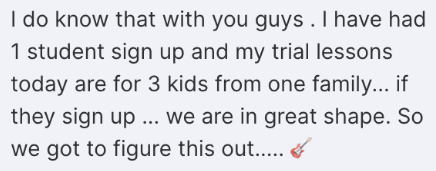
"If they sign up" is his, and it stays. Three kids from one family booked into a trial is three kids booked into a trial. It's a good day, not a result. Enrolling them is still the job.
Referrals are the same mechanism, one step later
A sibling is a referral with no persuasion required. The next easiest one is the friend from school, and that comes from a new family rather than an old one. A parent in their first eight weeks talks about the new thing their kid is doing far more than a parent in their third year, who stopped mentioning it long ago because it's just Tuesday now.
So the window for asking a new family for a referral is roughly the same window in which they're still excited. You've probably been asking the wrong people. The wall chart with "refer a friend, get a free month" is aimed at your most loyal families, who are precisely the ones least likely to be having new conversations about you.
There's a harder truth underneath this, and it's Neil's own argument rather than a marketing rule: referrals come from certainty. Nobody sends a friend into something that might waste their time. If your beginner class is inconsistent, or the instructor covering Thursday isn't as good as the one on Tuesday, or a parent's email took four days to get answered, they will say nice things about you and refer nobody. Referral volume is a measurement of how consistent your delivery is. Treat a dry referral month as information about the school, not about the poster on the wall.
When it works, it compounds into something no campaign produces. This is a school owner emailing us to pause his card:
"I had no idea that we'd be this full this quickly. Madscope leads, plus organic traffic, plus student referrals has us filled to capacity in just about everywhere, very quickly."
From an email a school owner sent us asking to pause his campaign, because the classes were full.
Note the order in that sentence. Paid, organic and referral stacking on top of each other is what fills a school. Any one on its own is slower than owners expect.
Where this sits in the follow-up
Some of it can be systematised, and some of it can't.
The part that can: whoever runs your follow-up should be going back to the people who've already booked and already shown. One owner, writing to another school owner who was weighing us up, described that side of it:
"They also reach out to these booked appointments for referrals and other events that we offer such as birthday parties."
From an email one school owner sent to another who was weighing us up.
He also described what happens after a trial student shows: the system follows up to ask how the experience was, and asks for a referral and a review at the same time. That's the right moment and the right sequence: how was it, then who else would like it. Asked in the other order it reads as a sales message.
The part that can't be systematised is the thirty seconds at the desk after the first class. Nobody can automate a person asking a parent about their other children. That one is yours, and it's the highest-return thirty seconds in the building.
The part we can't fix
We bring booked trials into your school and we're only paid when one physically walks in. We can't ask your parents about their other kids, we can't make your Thursday class as good as your Tuesday one, and we can't generate a referral from a family who had an average experience.
We also can't fix the version of this that costs owners the most: the sibling who would have joined, at a family rate, with no acquisition cost, and didn't, because nobody at the desk asked and the parent assumed the class was full. That one never shows up in any report. You'll never know it happened.
Where we sit in this
We get paid per student who shows up, so we have an obvious interest in you advertising. Read the above knowing that.
It cuts the other way as well. Siblings and referrals are students we don't get paid for. They arrive through the door we opened and they land on your mat at no cost to you, which is the cheapest growth in the business and also the part of it we can't bill for. We'd still rather you got good at it, because an owner whose cost per body on the mat keeps falling is an owner who stays with us. And when it fills your classes completely, the correct thing to do is pause, which several of our schools have done and nobody was charged for. There's no retainer here to make that awkward.
If you want to work out what this is actually worth in your school, book fifteen minutes. Bring your last twelve months of enrolments and the number of them that came in as part of a family. If you don't know that number, that's the most useful thing you'll learn on the call.
The short version
- Count memberships and bodies separately. Wadley's "that's not 30 people, that's 30 memberships" is the discipline to copy. One is your revenue, the other is your floor space.
- The sibling is worth a fraction of a fee and costs nothing to acquire. Put it in your cost-per-student maths using your own numbers, not an average you read somewhere.
- Keep it out of the ad, put it at the desk. The ad's job is one parent, one class time, one booking.
- Ask on day one of the trial, at peak excitement. Name a specific class on a specific evening and book the second trial before they leave.
- Ask new families for referrals, not your oldest ones. And if nobody refers you, look at the consistency of what you deliver before you look at the incentive.